27 in-depth topics + 30 concise workbooks + 3 applied capstones. All are open during the public beta.
Begin with the Australian energy landscape
A dedicated introduction to institutions, companies, assets, national energy statistics, prices and the outlook. Then use four numerical exercises and twelve judgement checks to prepare an industry brief. This introductory module complements the 60-topic map.
The same four routes shown on the homepage, with prerequisites and the full study order. Routes share some topics; choose the one closest to your needs.
Graduates & career changers
Start in energy
Explain how electricity reaches a customer, check MW and MWh, and identify who makes which decisions.
Before you start: No energy background needed. Start with units and basic arithmetic.
Follow ten topics from market architecture to dispatch, FCAS and settlement. The programme page shows the current assessment coverage and applied brief.
Foundation introduces concepts; Practitioner applies them to defined cases; Specialist integrates disciplines and uncertainty. Each topic has an explicit difficulty assignment, independent of its number or reading length. The 12 stages group related topics; standard topics contain a lesson, resources and a quiz; capstones centre on an applied decision pack with a four-dimension self-review. The eight-step starter route is a short route through the foundation topics, not a separate course.
From connection concepts to evidence
Topic 25 — Recognise the connection boundary, system-strength need and curtailment risk.
Topic 41 — Go beyond diagnosing a constraint: organise studies, model evidence, performance standards, commissioning and continuing compliance.
From system planning to investment
Topic 26 — Interpret an ISP scenario and distinguish a system pathway from a committed project.
Topic 40 — Go beyond the planning overview: compare network and non-network options, benefits and cost allocation.
Three different decision tasks
Topic 30 — Practitioner checkpoint: explain one market recommendation using a bounded evidence set.
Topic 50 — Specialist checkpoint: challenge the commercial strategy when assumptions change.
Topic 60 — Final integration: defend the commercial recommendation alongside safety, digital, resilience and implementation constraints.
1
Foundation
Can you explain the system?
Start with energy and power, generation, networks, storage, industry roles and market operation.
What to produce
Draw the supply chain, convert MW to MWh, explain who operates and regulates it, and distinguish a physical limit from a commercial agreement.
Ready to progress: Explain the mechanism without notes and reconstruct a simple calculation with correct units.
2
Practitioner
Can you reproduce an analysis?
Move into contracts, asset economics, interval data, forecasting and scenario analysis.
What to produce
Clean and join an interval dataset, reconcile costs, compare forecast errors, and reproduce a PPA, battery or project-finance calculation.
Ready to progress: Another person can trace your output back to the source rows, assumptions and calculations.
3
Specialist
Can you defend a decision?
Combine technical feasibility, market exposure, financing, uncertainty and governance in a case.
What to produce
Build an independent workbook, test an alternative, write a concise recommendation and respond to a reviewer's challenge.
Ready to progress: A competent reviewer checks both numerical correctness and judgement. This platform does not yet provide that independent marking service.
One project across six topics
Assess a data-centre energy plan using energy and power, large-load demand, exposure, contracts, storage and scenario analysis. Follow the worked case, solve a changed case and export a decision memo for review.
Original synthetic inputs, explicit model boundaries and a four-part review standard. Open practice with solutions—not a controlled exam or a tutor-marked assessment.
Use these three work products to connect the curriculum. Keep original data, working files and a dated source register together.
Interval-data analysis
Topics 31, 32 and 35: clean revisions and missing values, calculate energy and cost, compare forecasts on a consistent sample, and explain a chart. Repeat with the independent full-day dataset.
Commercial or asset case
Topics 21–23, 37 and 42: choose a contract, finance, storage or large-load exercise. Reconcile the base case, change an important input and distinguish technical feasibility from financial attractiveness.
Decision memo
Topics 47 and 60: state the decision, your recommendation, supporting evidence, a credible alternative, the largest limitation and a review trigger. Do not imply that a synthetic scenario is a real transaction.
How to review the work
Accuracy
Units, boundaries, signs and timing reconcile. Material errors must be corrected, not averaged away by a high quiz score.
Reproducibility
A reviewer can follow sources, revisions and formulas without asking you to recreate missing steps.
Judgement
Alternatives, uncertainty, constraints and residual risk support the recommendation.
Communication
A non-specialist can understand the decision, action and limits without reading every worksheet.
Use “not yet demonstrated”, “with guidance” and “independent” for each dimension. Independent performance on a new case is stronger evidence than repeating a worked example. These are suggested review criteria, not an accredited assessment framework.
Learning standard and course scope
Depth and coverage
The knowledge base contains 60 topics. 27 have extended teaching chapters and topic-specific question banks. A further 30 topics have concise guided workbooks, while 3 capstones require applied decision packs. Content length, task effort and difficulty level are different measures.
Coverage spans generation and fuels, networks, wholesale markets, customers, large loads, finance, data and professional practice. A broad map is not a substitute for deeper engineering, legal, trading or operational training.
20 case contexts include 16 original numerical case datasets. The analyst lab adds guided data and an independent full-day exercise. Congestion and operational-data lessons add independent engineering analysis exercises. Original teaching inputs are labelled synthetic; external reports supply context and should be checked for version and applicability.
Videos and audio are optional supplements. Read lesson notes and linked sources if a player is unavailable. External providers control availability, captions and access conditions; playback on every device has not been verified.
Records, feedback and qualifications
Quiz passes are device-local practice records, not identity-verified exam results. Reading and external study are not tracked. Export temporary working notes before leaving. The platform does not yet store submitted portfolios, provide tutor marking or issue an independently assessed qualification.
For job readiness, obtain feedback from a competent energy professional and practise on representative real data. Course completion alone does not establish engineering authorisation, a trading mandate or intermediate analyst performance.
How to use the material responsibly
Follow the source. Official publications support institutional and market explanations. Check the linked instrument, version, effective date and jurisdiction before using it at work.
Know the example. Original exercises use labelled teaching assumptions. A historical event, a simplified model and a live market observation are different kinds of evidence.
Show the working. Keep units, time periods, energy boundaries and assumptions visible. A correct answer without a reproducible method is not enough for a professional brief.
Challenge the conclusion. Test an alternative and state what would change your recommendation. Use competent review before a material operational or commercial decision.
Publisher and review status
Australia Energy Academy is an OohEnergy product. External organisations are cited as source publishers, not as sponsors, course reviewers or accrediting bodies. Read the publisher and editorial standard for accountability, review status and the current beta offer.
Found an error? Record the topic link, chapter title, disputed claim and a supporting source, then send it using Contact and feedback. Please exclude confidential operational or personal information.
Image credits
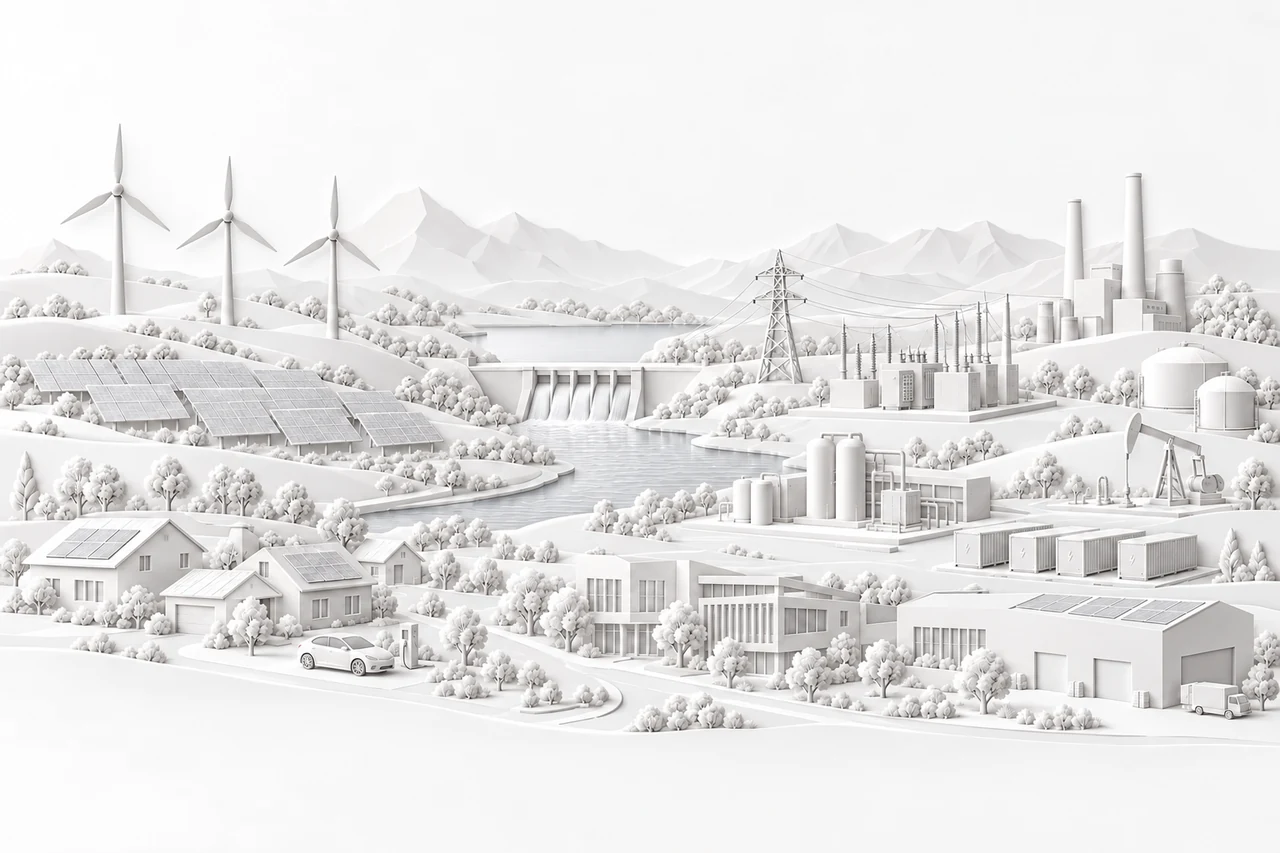
The white energy-system relief and energy-landscape images were created with generative AI for Australia Energy Academy. They are illustrations, not photographs of enrolled learners, staff, partner organisations or identifiable energy assets. Technical diagrams and charts are explained within their lessons.
Keep the learning current
Relevant rule changes and planning publications appear within each topic’s Watch & read section, alongside a practical question. You can also browse the course briefings index by subject. Each briefing retains its own source, status and check date.
Before you start
Do I need an energy background?
No. Start with the fundamentals lesson if MW, MWh and electricity markets are new to you. For the analysis routes, you will need basic arithmetic and spreadsheet skills. Choose a route that fits your role; you do not need to study all 60 topics in order.
How is this different from reading a report?
You work with the ideas: calculate a result, change an assumption and answer questions with explanations. Videos and official reports give you the wider context. They remain freely available from their publishers where stated, and their inclusion does not imply endorsement.
Will I get a qualification or tutor feedback?
This is independent, self-paced learning. It does not currently provide tutor marking, an accredited qualification or a guarantee of employment. Ask a competent colleague to review your independent work before using it in a professional decision.
Will my learning records follow me to another device?
Quiz passes are currently stored in this browser, not synchronised to an account. Saved private learning notes require sign-in. Export temporary scratchpad work before leaving; clearing browser data can remove local progress.